IHE [WAHH]
Level 0: Governance and Strategic Vision
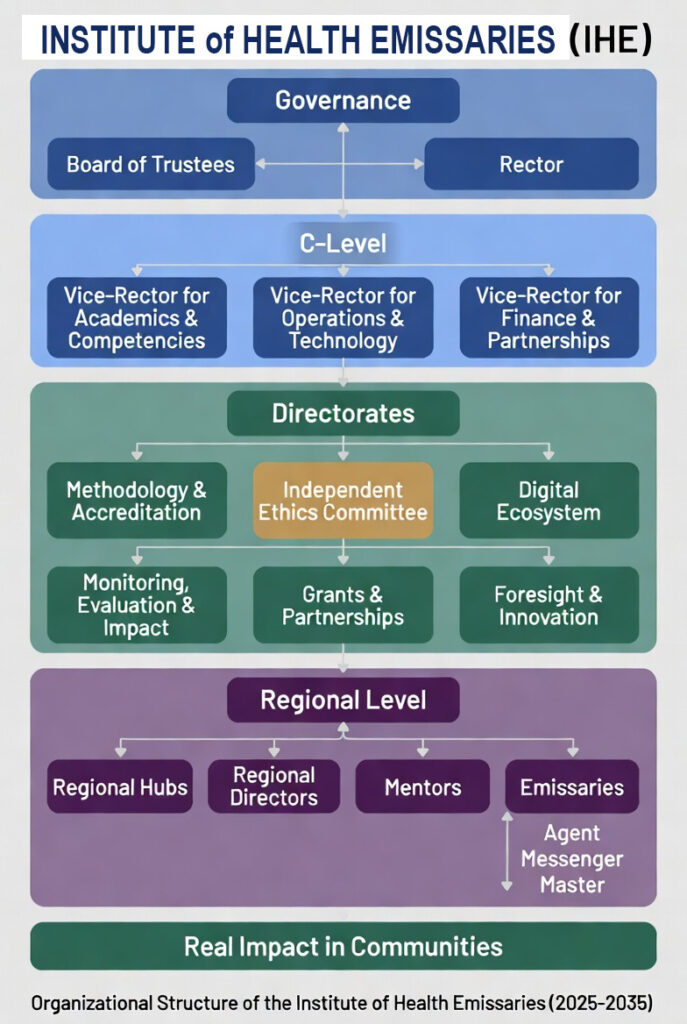
Board of Trustees
- 9–11 members, with 1/3 rotation every 3 years.
- Mandatory Composition: Representatives of WAHH, WHO/UNICEF (observers), major philanthropists, world-class scientists, and one or two “Grand Emissaries.”
- Authorities: Approval of Strategy-2035, ethical protection of the brand, appointment/removal of the Rector, and approval of the annual budget and key impact KPIs.
International Scientific and Ethical Council (Consultative body)
External experts (Harvard, LSHTM, WHO Collaborating Centres, etc.).
Level 1: Global Executive Leadership (Global HQ, Bern, Switzerland + Virtual Office)
Rector (CEO & President)
- The public face, diplomatic level. Reports to the Board of Trustees.
Three Vice-Rectors (C-level team):
- Vice-Rector for Academic Standards and Competencies (Chief Academic Officer)
- Owner of the “Spiral Competency Model” (Agent → Envoy → Master → Grand Emissary).
- Curriculum development, accreditation, quality control, and Scientific Advisory Board.
- Digital Academy (LMS + AI Tutor).
- Vice-Rector for Operations, Networks, and Technology (Chief Operations & Network Officer)
- Scaling of regional hubs.
- Logistics of field programs and internships.
- Owner of the HEI digital ecosystem (LMS, Impact Map, CRM, Blockchain Certificate Registry).
- Vice-Rector for Finance, Sustainability, and Partnerships (CFO + Chief Partnership Officer)
- Diversified model: 50% grants/philanthropy, 30% corporate programs (B2B wellness & corporate emissaries), 15% membership fees and micro-crowdfunding, 5% internal social enterprises.
- ESG and impact investments.
Level 2: Central Functional Directorates (Centers of Excellence)
- Directorate of Methodology and Accreditation (Center of Excellence)
- Development of the three-level modules + continuous content updates.
- Certification and Registry of Emissaries.
- Database of best practices + AI case analysis.
- Directorate of Monitoring, Evaluation, and Impact (M&E Impact) — Core critical block
- Unified KPI system (DALYs averted, reach, behavioral changes, systemic shifts).
- Independent external evaluations every 2 years.
- Real-time Impact Dashboard for donors.
- Independent Ethical Committee (Separate legal entity reporting directly to the Board)
- Autonomous status.
- Code of conduct, oath, whistleblowing, and revocation of status.
- Ethical expertise for all major projects.
- Directorate of Communications, Brand, and External Relations
- “Stories of Change” (podcasts, documentaries, scientific storytelling).
- “Gold Standard” strategy in public health.
- Directorate of Strategic Foresight and Innovations
- Trend monitoring (longevity, AI in healthcare, climate and health, neuroscience).
- Piloting breakthrough approaches.
- Idea factory for future Master programs.
Level 3: Regional Hubs (8–10 hubs by 2030)
- Regional Director (Authority over adaptation and local fundraising).
- Hub Team: Learning & Field Coordinator, M&E Specialist (local), Partnership Manager.
- Model: “Global standards + 30–40% local adaptation.”
Level 4: Execution Network and Field of Activity
- Program Curators / Cohort Coordinators (Master level).
- Mentors (Key resource). Mandatory pedagogical training + annual supervision.
- Emissaries (Agent → Envoy → Master → Grand).
- Local Nodes (Community Nodes) — Schools, clinics, NGOs, corporate wellness centers.